Immerse yourself in a captivating conversation with debut historical romance author Kate, who transitioned from writing ‘terrible holiday diaries’ to creating riveting narratives that transport readers from New York to Ireland during the early 20th century. Juggling the diverse roles of a farmhand, wife, and author, Kate’s journey to publication with The Book Guild offers inspiration to authors, and her tales of love and misadventure allure thriller enthusiasts. With her next novel in the pipeline, and a short story published by Fairlight Books, Kate’s world is rich with stories that promise intrigue and suspense. Delve into this interview for a glimpse of her multifaceted life and creative process.
Can you tell us about your journey to becoming an indie author?
Four years ago, my farming husband suggested I self-publish the novel I was drafting. Silly boy; what did he know about the publishing world as he drove his tractor up and down the fields?
I wrote and edited the book. Then had it critiqued. Re-wrote the book again. Three times. Began the submission process and received some agent interest and was asked for ‘the full’ on a few occasions. The timeline was so specific, some didn’t know how they’d ‘sell’ it to publishers and one even asked if I could re-write it set in WWII as those books were “doing quite well.” I replied that I couldn’t because Titanic makes a cameo appearance towards the end of the book. My husband shook his head and repeated his advice, as he ploughed his way across a stubble field answerable to no-one but himself.
After further agent 1-2-1s and a couple of submissions to editors at digital first publishers, the positive feedback was at least building my confidence that I could write something better than a shopping list. Maybe my husband had a point.
I began to look into self-publishing and knew it would take a long time for me to feel able to press the PUBLISH button. I needed help. So I switched tracks, and attended the 2022 One Day conference at Troubador in Leicester; home to both Matador self-publishing services and The Book Guild who offer mainstream publishing and Partnership publishing hybrid contracts. I submitted ‘Maid of Steel’ to TBG and a month later was offered a partnership contract, which I immediately sent over to the Society of Authors, convinced they must be a vanity publisher and would take all my money and Rights and do nothing in return.
But the SoA were very complimentary about the ‘transparent and fair’ contract I had sent them. They were particularly impressed that my Book Rights would be with TBG for 12 months only, after which I had the option to go purely self-published or to renew with them. All other rights, including TV, Film, Audio, lending and so on remained with me. The breakdown of my financial contribution made it crystal clear that I’d be spending no more than if I was shouldering the weight on my own shoulders of finding a cover designer, an editor and copious amounts of marketing.
I signed. My husband shook his head and mumbled ‘Finally’ as he positioned an irrigator to water the potatoes…

Can you share one of the most rewarding experiences you’ve have had as an indie author?
The email from The Book Guild which included the proposed cover design for Maid of Steel was a memorable day. I was travelling to Yorkshire from Suffolk to attend a course run by Sophie Hannah, and had stopped in Bradford for a couple of hours’ research for my next novel, The Projectionist.
I parked the car and caught up with emails. When I opened the attachment I actually gasped out loud. Then I cried and had to calm myself before calling my project manager with feedback. I don’t know how often authors with The Book Guild negotiate changes, but this wasn’t one of them. I never altered a thing from Chelsea Taylor’s interpretation of my very basic sketch, sent a couple of weeks earlier.
Another momentous moment was filming my unboxing video. They’d become a thing over the previous few years and I’d watched so many authors enjoying seeing their paperbacks for the first time. I filmed mine in the workshop on the farm; the place I spend many hours every day for my day-job, washing, reproofing and repairing horse rugs for equestrian clients in my local area. Pennies earned from that work had paid for writing courses, webinars and events over the previous few years and it was those clients I wanted to thank for helping me get to that point – an author admiring a book with her name on the cover. It’s still one of my favourite reels on Instagram!
Can you tell us about any upcoming projects you’re excited about?
Following on from the previous question, I’m itching to get stuck into the first draft of The Projectionist. I can ‘see’ it all, but translating that into words on the page is proving difficult. I’ve had two main characters but recent days spent taking inspiration from real life is helping to narrow down the theme of this next novel, which will also be historical – this time 1953 set partly in the Suez Canal Zone and partly in East Anglia during the great flood.
I’ve been to the British Army Museum and bought books on the National Service and have been getting to know Frank, the guy who spent his life being the projectionist at his local cinema. The book will open with Frank as an old man, walking past the disused cinema, remembering the good times and trying to forget the nightmares.
And another writerly project I’m excited about is developing my website from the basic thing it is now to something dynamic, courtesy of help from Grant at Digital Authors Toolkit. I’ve seen him two years running at the Self-Publishing Formula Live show in London and have decided to bite the bullet and do it properly and am intrigued with what fabulous designs he will come up with. Having only one book out so far is no reason not to treat the writing journey with commitment. I want to keep writing, so having my own corner of the internet will be vital.
Are there any movies or TV shows that have inspired your storytelling?
The old Bradford cinema is being refurbished as we speak; delayed by the pandemic, but now on track for opening as an Arts and Entertainment Venue very soon. The Michael Portillo tv series ‘Hidden Histories’ had aired an episode about this cinema in November 2018 which I watched in Sheepwash in Devon, following a writing course at Retreats for You (like I say, I’ve spent lots of money and time on course and not enough time writing books!)
The episode inspired the story which I’m now developing. The idea for Frank’s tale has never left me, and that’s a sure sign that a story should at least be given a chance to exist.
Since studying the art of writing, I can no longer watch any film or drama without analysing the structure and character arc. I drive my family mad by calling out the beats I recognise; they tell me to “shut up and watch the film!”
What’s your ‘guilty pleasure’ TV show, book or movie, and have elements of it ever ended up in your writing?
I adore contemporary crime drama, which couldn’t be further from historical romance! Give me The Equalizer with Denzel Washington any day, or Wallander or Luther detective series with flawed and troubled main characters. I enjoy gritty plots and dangerous scenarios. I read in these genres too as I want my pulse to race with fear. I love action films and the 007 franchise remains a firm favourite (although my heart is still broken). I have all the films but love how James Bond became modern man and more of an equal from his sexist 60s and 70s self! Times change and fiction needs to keep up. Anthony Horrowitz writes brand new 007 books and I thoroughly approve of his style and plots.
How has your background influenced your writing style and the stories you choose to tell?
Being an RAF brat – as kids of Royal Air Force parents were always affectionately known – I’ve always had an interest in the military and especially planes. Airshows were a big part of my childhood! Being an only-child who was frequently asked by an engineer-father to help him work on his cars meant I developed a fascination for vehicles which perhaps my fellow female schoolfriends didn’t generally have. There is a scene in Maid of Steel involving a non-fatal car crash and it was my father with whom I swapped some emails to discuss inertia, 1911 tyres and the lack of power-steering!
We moved every three years as dad was posted from one tour to the next and I went to a number of schools including a boarding school in Stamford in Lincolnshire at one point. Dad was posted at the time to RAF Wittering and even now I can’t drive past the Harrier jet on the A1 without feeling the nostalgia trickle through my veins. My next novel, The Projectionist, will feature a military vehicle or two and although dad is now 82 and suffering from acute COPD, it is my dream to visit Duxford with him this summer to enjoy a research trip together.
I’m an only child and left school at sixteen with three ‘O’ levels (and I’m old enough to have missed the GCSE style of exams). I began work and have never been out of employment. I married a farmer in 1994 which may have had something to do with wanting to put down roots and although I don’t actively feel my own nomadic upbringing was a negative thing, when folk used to ask where I was from it was an impossible question to answer. The female characters I’ve written to date (I’ve manuscripts that have not yet seen the light of day that are separate to Maid of Steel!) are all very comfortable in a man’s world and I suppose that may well be a legacy of my upbringing. I wanted to be the son my father never had, yet he would probably tell us he’s proud to have a daughter who could do all the things a son could have done. In fact, I know he’s proud of me because he told me only a few weeks ago. He’d finished reading my novel and while I waited with baited breath to hear what he thought, I cast my eyes over the piles of John Le Carré novels, Grisham, Wilbur Smith and Robert Harris. “I got to the half way mark and was enjoying the story, but then I couldn’t put it down. The characterisation was great and the crash scene very good.” He’s not a man who is known for his emotional highs, so this was praise indeed. And I couldn’t have been happier.
What about your book are you most proud of?
Its existence. I took an idea which began life as one sentence over a glass of wine following a visit to the Heritage Centre in Cobh near Cork. That nugget developed into a full story which evolved over months of planning and years of writing to its final version and is now being read by people out in the world. I still can’t quite believe it.
What are you working on?
The Projectionist is a story about living with loss and regret. Frank is a widower who is waiting to join his wife in the next life and their small son who, in 1953, lost a battle with pneumonia following the great floods. Frank had been away, stuck in the desert on National Service. When he meets Toby, a young boy intent on running away from home, Frank’s day to day existence begins to take on new meaning.
An idea for the future?
I’d like to rewrite a manuscript I began (and finished) in 2017 but is presently lining the potato drawer in the kitchen. Feuding Mafia brothers in Tuscany where Antonio discovers it’s almost impossible to walk away from the family. The arrival of Edinburgh-based carer Martha, claiming to own the vineyard where the boys grew up, throws a cat among the olive trees. Martha had been looking after the boys’ Aunt in Scotland until she died. But why would their Aunt have had claim to the property when it was her sister who in the 1960s had fallen in love with their Italian father and made her home on the banks of Lake Garda?
I also have a thriller series in mind set in a quaint English village. Each book would tell the story of a different couple or family unit who live around the green. Book 1, presently drafted as ‘Agatha & Vincent’ tells the story of Agatha’s past coming back to disrupt their tranquil twilight years. Unbeknown to Agatha, the child she was forced to give up in the 1970s has passed away from illness, but not before he had had a child of his own. Guy has carried his anger for too long. He’s spent months tracking down his birth grandmother and now wants to know why she gave up his father and ruined both their lives.
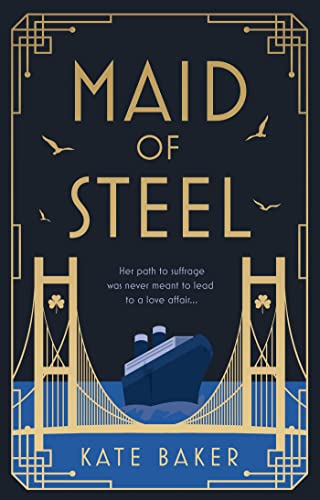
MAID OF STEEL
It’s 1911 and, against her mother’s wishes, quiet New Yorker Emma dreams of winning the right to vote. She is sent away by her parents in the hope distance will curb her desire to be involved with the growing suffrage movement and told to spend time learning about where her grandparents came from.
You can find Kate Baker at her web site, or on her Amazon Author page.
 Damian Vargas's author blog
You must be logged in to post a comment.