Welcome to an intriguing conversation with up and coming author Luke Richardson, whose globetrotting experiences inspire his thrilling literary universes. With three series under his belt, including the ‘Eden Black Archeological Thrillers,’ ‘International Detective Bureau,’ and ‘The Liberator,’ Luke blends adventure, mystery, and cultural exploration into his narratives. Drawing upon vivid memories from places like the bustling streets of Mumbai, his stories emphasise the inherent goodness within humanity. Whether you’re an author seeking inspiration or a reader in love with thrillers, this interview offers a captivating glimpse into Luke’s creative world.
How do you find inspiration for your stories and characters?
Everywhere, is the answer to that question. And I never quite know where they are going to come from. It could just be in a conversation with someone. It could be from reading an article in a newspaper. Travel is an important thing for me, the locations of the story and the way that intertwines with the actions is very very important, so travelling to places does open those ideas and allows those ideas to flow. Whether that is learning about the history of a location, or walking into a market and thinking ‘Wow, this would be a great place for a chase scene. Or looking at the rooftops of some town in a rural place, and thinking about how this or that could happen. Or learning about a myth or a legend, you know, particularly with my new series that is following a historical or archeological element.
How do you handle criticism and negative reviews, especially being self-published?
Do you know what, now is very different to how I was before. When I published the first books, I just wouldn’t read the reviews that were below 4 or 5 stars. I was like, ‘I don’t want to hear it.’ And now I’m very different. Actually, I appreciate it. I read those odd low reviews and I think ‘Fair enough’, because that review has happened for several reasons, one of which may be that the wrong person picked up the book. Which is absolutely not my fault, it’s nothing to do with the book, it’s just that it wasn’t the right book for them. And secondly, it could be a valid criticism. I’ve had comments on my books that, actually, I’ve gone back and re-edited and re-written. And that person has given me advice that I would have paid thousands of dollars for a developmental editor to find, or I’ve had an editor who hasn’t picked up on that issue.
How do you balance writing with other aspects of your life, like family, friends, and work?
For me it’s different because I sort of am a full-time author, I’m sort of not. I do other things, other freelance work as well. But it’s different, I don’t have a full-time job. I don’t have a job that’s regular, so it works really well. And ultimately, I don’t really balance the writing with other things, I get obsessive about it. I get into the process, and I get completely absorbed into it and I ignore everything else for a period of time, and then I come back and spend time doing those other things. I do also think that with writing that there is a limit that you can spend putting fingers on keyboards. Certainly, for me. I get to two or three thousand words in a day and I’ve had enough, I want to go and do something else. So, it does mean I have a good chunk of the day to go and do those other things. Although it doesn’t mean I’m not thinking about it whilst I’m out, walking around, or in the pub with friends, my mind is still churning over what I’ve done, and what I’m going to write tomorrow. But there is a sort of innate balance, and also no balance at all, because I do get quite obsessed about the story that I’m working on.
Can you tell us about any upcoming projects you’re excited about?
Yes, I am now, my last book the Atlantic Agenda was out last week, and it was a great launch. I’m really pleased with it. People are reading it now and the reviews are coming in now which is fantastic. But not wanting to sit around, I’m jumping straight onto the next one, The Titanic Deception which I am working on at the moment. I’m just past about twenty thousand words, and I’m really pleased with it. I don’t plot my books in advance – I have an idea and I just run at it and see what comes out. So it makes the process of discovering the story really interesting. I love that.
What are your favourite genres to read or watch, and how do they influence your writing?
Now, I am quite strict about this. When I’m writing something, I only read books that I aspire towards. If that makes sense. So, when I’m writing a book, I won’t just go and read anything, I’ll only read books that I want my book to sort of aspire to be like because I don’t want to get distracted, reading a murder mystery when I’m writing an archeological thriller. As I’ll think, that’s a great element, let’s have a think about how I could work that into my book. But it wouldn’t work because that’s a completely different book. So, at the moment, I’m on a strict diet of archeological thrillers, from authors like Clive Cussler, James Rollins, these sorts of guys. Maybe when I turn my attention to working on something else, I will change what I read as well.
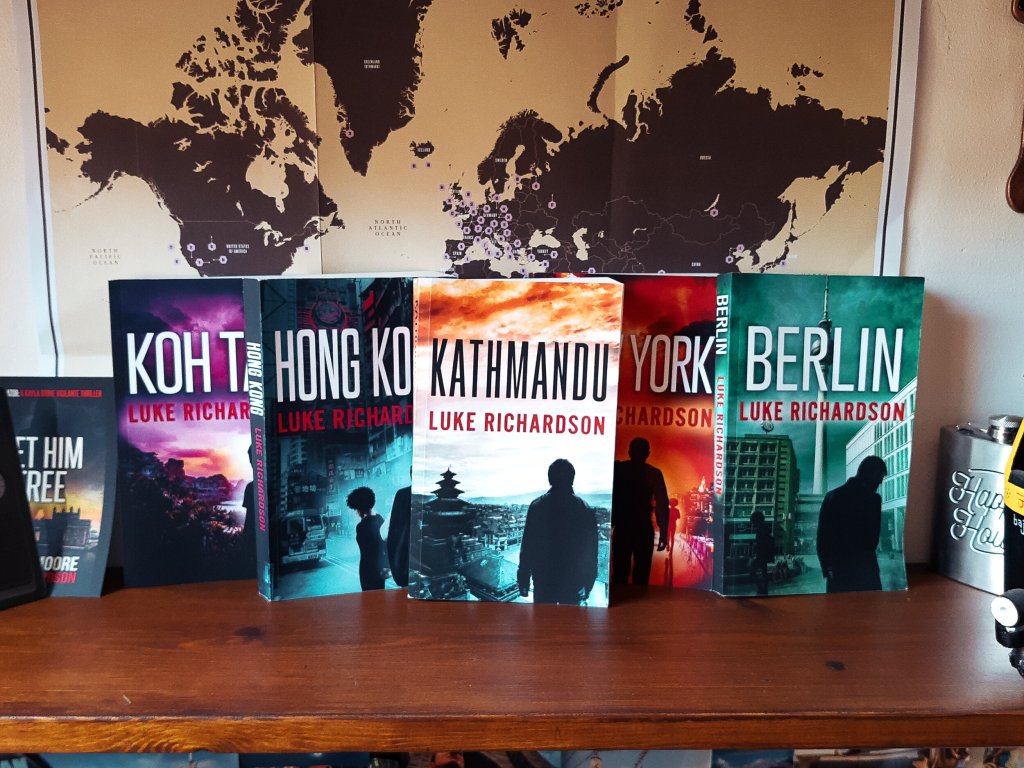
What are the things in life that truly excite you and how do they transpose into your writing?
Again, I’m going to talk about travel, going to different places. Putting myself in different situations, seeing different things. This, for me, is both the reward of writing, and it’s the inspiration for writing as well. I love that I’m able to travel to different places, funded and in aid of my writing. And I love to know that I can write whilst I am there, it’s my work and I can take it anywhere that I like. I also like how that transposes itself into the writing. I wrote the books in Egypt, and I like the feeling that I was capturing some of the magic of those places, that I was promoting the magic of those places to my readers. That feeling is wonderful, and I really enjoy doing that.
What of your book(s) are you the most proudest of, and why? What was the hardest book of yours to write, and why?
I think I’ve got to say the first one. I was certainly the most difficult and I struggled to write it. It’s now been re-written several times and it’s better than it’s ever been before. It’s a very different book to what it was at that moment. It was an uphill struggle, because back then I was working full time at that point. I was getting up early to write a few hundred words before work, as many authors talk about, and I didn’t really know what I was doing. I didn’t really know what type of book it was, and the fact that I didn’t give up with it, I just got on with it and I finished it. I’m still very proud of. That said, I’m proud of all of them. I’m particularly proud of this new series as readers seem to love it. But, yeah, I’m most proud of that first one. The difference between zero an done, is always bigger than the difference between book one and book two, book ten, or book one hundred. Because it’s about going to something from nothing. And the first time you do anything is always a great achievement. And it was also the hardest book to write, because it was literally like moving forward inch by inch.
Is there a book project you have in mind that you plan to write one day? If so, can you tell us a little bit about it?
I would love, at some point, to write a murder mystery. I have always loved MMs. Even as a child, watching the likes of Poirot, and trying to figure out who it was. And I love the idea of trying to write one of those, one day. A story with ten or so suspects, and having the readers trying to work out who the murderer is. I don’t know when I’ll do that, I keep saying I’ll do that next year, for about five years. I will do, one day. I love the idea of it. It’s a completely new genre for me, so it’s going to take some work, and some research.
You can find Luke Richardson at his web site, or on his Amazon Author page.
 Damian Vargas's author blog
You must be logged in to post a comment.